4 Seasons in India – A Beautiful Cycle of Nature
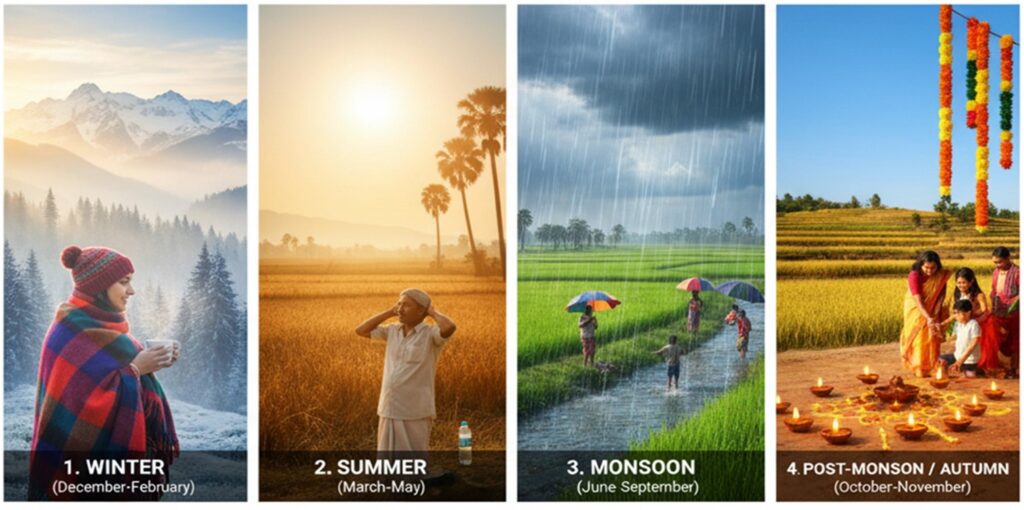
Table of Contents
Introduction: India – A Land of Diverse Seasons
India is a vast country with different types of weather and climate conditions throughout the year. From the snow-covered Himalayas in the north to the hot deserts of Rajasthan, and from the coastal humidity of Kerala to the dry plains of Madhya Pradesh — India’s climate changes beautifully across regions and months.
The Four Main Seasons in India
- Summer (March to June)
- Monsoon or Rainy Season (June to September)
- Autumn / Post-Monsoon (October to November)
- Winter (December to February)
Sometimes, people also include Spring (February to March) as a fifth season because it has its own charm — a time when flowers bloom and nature looks fresh.
Each season brings different temperatures, weather patterns, food habits, clothes, and festivals. In this essay, we will understand how these seasons affect the life of Indian people and the environment.
Summer Season in India (March – June)
Summer is the hottest season in India. It begins around March and lasts till June. During this time, most parts of India experience high temperatures, sometimes reaching 45°C or more.
Days are long, hot, and dry, while nights are slightly cooler.
Regions Affected
- Northern India: Delhi, Rajasthan, Uttar Pradesh, Haryana face scorching heat and dust storms.
- Western India: Gujarat and Maharashtra experience hot, dry winds called Loo.
- Southern India: Places like Kerala and Tamil Nadu remain hot and humid due to their closeness to the sea.
- Hill Stations: Places like Shimla, Manali, and Darjeeling remain cool and become popular tourist spots.
Activities and Lifestyle
- People wear light cotton clothes to stay cool.
- They drink cold drinks, lemon water, buttermilk, and coconut water to stay hydrated.
- Fans, coolers, and air-conditioners are widely used.
- Schools often declare summer holidays during May and June.
Fruits and Food
Summer is famous for its delicious fruits like:
- Mangoes 🥭
- Watermelons 🍉
- Litchis 🍒
- Cucumbers 🥒
People also enjoy ice creams and cold drinks during this season.
Importance
Summer helps farmers prepare their land for the monsoon crops like rice, sugarcane, and cotton. It is also a time when sunlight is available in abundance, useful for solar energy and drying grains.
Monsoon Season in India (June – September)
After the burning summer, comes the monsoon season — the most awaited season in India. It starts around June when the southwest monsoon winds bring rain from the Arabian Sea and the Bay of Bengal.
The first showers usually touch the coast of Kerala and then spread across the country.
This season continues till September.
Weather and Climate
- Frequent rains, thunderstorms, and cool winds refresh the environment.
- Rivers, ponds, and lakes get filled with water.
- The temperature becomes moderate and pleasant after long months of heat.
Importance for Farmers
The monsoon season is the lifeline of Indian agriculture. Most farmers depend on rainfall to grow crops such as:
- Rice
- Sugarcane
- Jute
- Cotton
- Maize
Without timely rain, crops may fail, affecting the entire economy.
Problems During Monsoon
- Sometimes heavy rains cause floods, damaging homes and fields.
- In some areas, too little rain causes drought.
- Waterlogging, traffic jams, and diseases like dengue and malaria are also common.
Beauty of Monsoon
Despite these problems, monsoon is the most refreshing season. Trees look greener, fields are full of life, and the air feels fresh and clean.
As a famous saying goes:
“The monsoon washes away the dust and gives new life to the earth.”
Autumn / Post-Monsoon Season (October – November)
Autumn comes after the rainy season, usually between October and November.
It is a transition period between the rainy and winter seasons.
The weather becomes clear, dry, and pleasant.
Skies are blue, the air feels clean, and the temperature slowly starts to drop.
Features of Autumn
- The ground becomes dry again after the rains.
- Trees shed old leaves and prepare for new growth.
- The air is neither too hot nor too cold.
Agricultural Importance of Autumn
Autumn plays a crucial role in India’s agricultural calendar. It marks the end of the Kharif season, when major crops such as rice, maize, cotton, and sugarcane are ready for harvest. Farmers work tirelessly during this period to collect, thresh, and store their produce. The success of the autumn harvest largely determines the country’s food supply and the economic stability of rural communities.
At the same time, autumn serves as a period of preparation for the Rabi season. After the monsoon rains have receded, the soil becomes suitable for sowing winter crops like wheat, barley, mustard, peas, and gram. Farmers plough their fields, apply fertilizers, and ensure proper irrigation to make the land fertile for the next cycle of cultivation. Thus, autumn acts as a bridge between two major agricultural phases—harvest and sowing—making it one of the most significant seasons for Indian farmers.
Natural Beauty of Autumn
Autumn is also known for its serene and picturesque beauty. The sky appears clearer and bluer after the rainy season, and the air feels crisp and refreshing. Trees begin to shed their leaves, painting the landscape in warm shades of gold, orange, and red. The pleasant temperature and low humidity make it an ideal time to enjoy outdoor activities and festivals.
In India, autumn coincides with many vibrant celebrations such as Durga Puja, Dussehra, and Diwali, which add color and joy to the season. This period is also considered the best time for tourism and travel, as the weather is neither too hot nor too cold. Hill stations, historical sites, and natural parks attract travelers from across the country and abroad, offering breathtaking views and comfortable experiences.
Winter Season in India (December – February)
Winter is the coldest season in India, starting from December to February.
The temperature falls below 10°C in northern India, while southern states experience mild winter.
Weather Conditions
- Cold winds blow, especially in northern plains.
- Hill stations experience snowfall, turning them into beautiful white landscapes.
- The days are shorter, and nights are long and cold.
Regions and Climate
- Northern India: Jammu & Kashmir, Himachal Pradesh, Uttarakhand, and Punjab face severe cold.
- Central and Western India: States like Madhya Pradesh and Gujarat have pleasant winters.
- Southern India: Kerala and Tamil Nadu enjoy mild and comfortable weather.
Lifestyle and Food
- People wear warm clothes like sweaters, jackets, and scarves.
- Foods like soup, tea, coffee, peanuts, and jaggery (gur) are common.
- Sunbathing becomes a favorite activity in villages.
- Bonfires are lit in the evenings to keep warm.
Importance
Winter is the best season for farming wheat, mustard, and vegetables.
It is also the tourist season in many Indian states because of the cool and comfortable weather.
Spring Season in India (February – March)
Though India officially recognizes four seasons, spring is often celebrated as a separate season due to its natural beauty.
Spring is the most pleasant and colorful season in India. It comes between winter and summer (around February and March).
During this time, flowers bloom, the sky is clear, and nature looks fresh.
How Seasons Affect Indian Life
The four weather seasons in India affect almost every part of human life:
Aspect | Summer | Monsoon | Autumn | Winter |
Clothing | Cotton | Raincoats, umbrellas | Light clothes | Woolen |
Food | Juices, fruits | Hot snacks | Sweets, festive food | Soups, dry fruits |
Agriculture | Land preparation | Main crop growing | Harvesting | Winter crops |
This cycle of seasons helps balance nature, support agriculture, and make life colorful and rhythmic in India.
The Beauty and Diversity of Indian Seasons
India’s climate diversity makes it a unique country.
While one region may enjoy rain, another may have snow or sunshine at the same time.
This seasonal variety:
- Brings different festivals and traditions.
- Supports a wide range of crops.
- Attracts tourists throughout the year.
Truly, the beauty of India lies in its changing seasons and their harmony with people’s lives.
Conclusion
The four seasons in India — Summer, Monsoon, Autumn, and Winter — show the wonderful balance of nature.
Each season has its own importance, beauty, and challenges.
Summer gives us energy, Monsoon brings hope and greenery, Autumn fills our lives with light, and Winter brings peace and comfort.
Together, they make India’s climate one of the most diverse and fascinating in the world.
We must appreciate every season for its gifts and learn to live in harmony with nature.
Vocabulary and Phrases Table – 4 Seasons in India
Word / Phrase | Meaning in Hindi |
Weather | मौसम |
Climate | जलवायु |
Season | ऋतु / मौसम |
Temperature | तापमान |
Humidity | नमी |
Rainfall | वर्षा / बारिश |
Monsoon | वर्षा ऋतु |
Scorching Heat | झुलसा देने वाली गर्मी |
Thunderstorm | गरज के साथ तूफ़ान |
Drought | सूखा / बारिश की कमी |
Flood | बाढ़ |
Harvesting | फसल काटना |
Transition | परिवर्तन / बदलाव |
Humid Climate | आर्द्र जलवायु / नमी भरा मौसम |
Blooming | खिलना / फूलना |
Agriculture | कृषि / खेती |
Breeze | ठंडी हवा |
Bonfire | अलाव / आग तापना |
Umbrella | छाता |
Solar Energy | सौर ऊर्जा |
Balance of Nature | प्रकृति का संतुलन |
Crucial role | महत्वपूर्ण भूमिका |
Agricultural calendar | कृषि पंचांग / कृषि चक्र |
Kharif season | खरीफ मौसम |
Harvest | फसल की कटाई |
Produce | कृषि उत्पाद |
Economic stability | आर्थिक स्थिरता |
Rural communities | ग्रामीण समुदाय |
Receded | घट जाना / पीछे हटना |
Suitable | उपयुक्त |
Sowing | बुवाई |
Fertilizers | उर्वरक |
Irrigation | सिंचाई |
Fertile | उपजाऊ |
Cultivation | खेती / कृषि |
Bridge between two phases | दो अवस्थाओं के बीच पुल |
Agricultural phases | कृषि की अवस्थाएँ |
Harvest and sowing | कटाई और बुवाई |
Serene | शांत |
Picturesque | मनमोहक / सुंदर दृश्य |
Crisp air | ठंडी और ताज़ा हवा |
Shedding leaves | पत्तों का झड़ना |
Warm shades | गर्म रंग (लाल, नारंगी, पीला) |
Humidity | आर्द्रता |
Ideal time | उपयुक्त समय |
Vibrant celebrations | जीवंत उत्सव |
Coincides with | साथ-साथ घटित होना |
Add color and joy | रंग और खुशी जोड़ना |
Tourism and travel | पर्यटन और यात्रा |
Comfortable experiences | आरामदायक अनुभव |
Hill stations | पहाड़ी स्थल |
Historical sites | ऐतिहासिक स्थल |
Breathtaking views | मनमोहक दृश्य |
Pleasant weather | सुहावना मौसम |